US Expansion Guide
From the American myth to a controlled trajectory.

THE MISSION
KEY FIGURES
Find out in this guide
A PMF to rebuild
A European PMF does not carry over. The guide recommends targeting a precise niche and being 3 to 5 times better than the competition on at least one key point.
3 million at the very least
In the United States, everything costs two to three times more. Plan for at least 3 million dollars over several years, and up to 10 to 15 million depending on the sector.
The founder on the ground
Without a founder really on the ground, there is no US foothold: the founder hires the landing team and gives the company credibility with customers and investors.
SUMMARY
With the support of:

Become a member to access the full publication
Access the entire guide and receive updates
Share the guide


GOING US: NO SHORTCUTS
Setting up in the United States is no longer a fantasy reserved for a handful of startups. For many French founders, it has become a natural path as soon as the ambition is to change scale. Market size, buyer maturity, depth of budgets, speed of execution: the US market offers opportunities that Europe still struggles to match.
But this obvious truth hides a more complex reality. Expanding to the US is neither a sales extension nor a simple copy of the European model. It is a deep transformation of the company. Product, positioning, organization, hiring, funding, legal framework, decision-making pace, the founder's personal balance: everything is affected. And mistakes made in the United States are expensive. In money. But above all in time.
This guide starts from a simple observation: too many decisions are still made on misleading signals. A first American customer is not product-market fit. A deal signed after a trade show is not a strategy. A European PMF does not carry over mechanically. And leaving "when everything is going well in France" can sometimes make the move harder, or even irreversible.
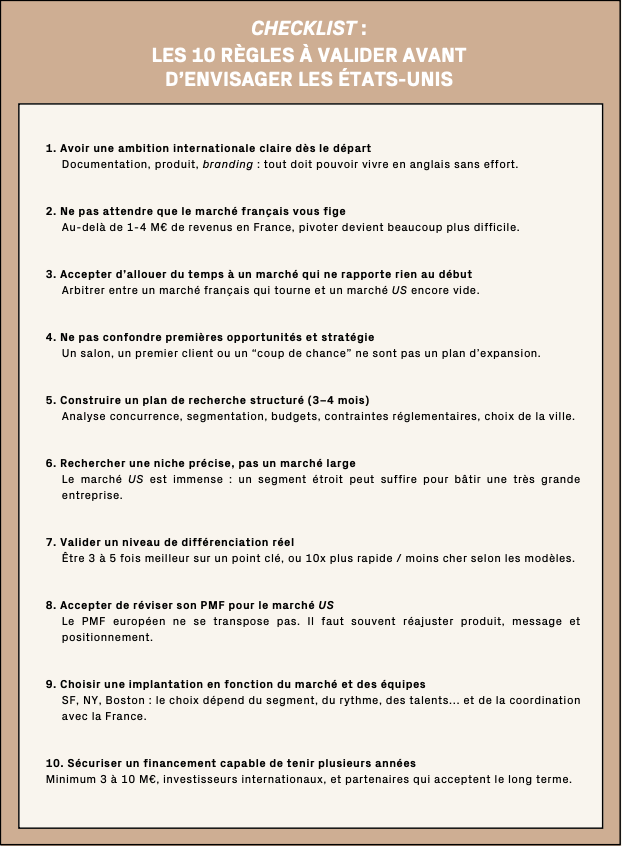
The aim of this guide is not to convince everyone to go to the United States. It is to bring clarity. To help founders answer the real questions, at the right time:
- When does it really make sense to go to the United States?
- How do you build a product-market fit that is specifically American?
- Where should you set up to maximize your chances of success?
- How much money do you need to last over time?
- What role should the founder play on the ground?
- How do you hire, structure and run transatlantic teams?
- What legal, tax and personal blind spots should you anticipate?
“This playbook is not a promise of success. It is a guide to clear thinking. The goal is not to push everyone to go US. The goal is to help those who go do it at the right time, for the right reasons, with preparation that matches the level of risk, and therefore the level of ambition.”

What does the US Expansion Guide cover?
The guide brings together the experience of eleven Galion founders who launched in the United States (Botify, Welcome to the Jungle, Strapi, Nabla, AB Tasty, Upsun, Potloc, Moments Lab…) and legal and tax insights from the law firm White & Case. It follows three stages.
Deciding to go, without trusting false signals
The US B2B software market will be worth nearly 200 billion dollars by 2029, more than twice the European market. But a first American customer is not product-market fit, and a deal signed after a trade show is not a strategy. The founders interviewed advise thinking global from day one, and not waiting until the French market locks the company in: beyond 1 to 4 million euros of revenue in France, changing course becomes much harder. A detour through the United Kingdom or Canada is not always a springboard: it can cost years.
Building solid foundations
The first step is to rebuild a truly American product-market fit, on a precise niche. The choice of city follows: nearly 60% of Galion members based in the United States are in New York, around 15% in San Francisco, and just over 10% in Boston. Costs are two to three times higher, and founders there earn around €200K a year, compared with a median of €120K in France according to Galion's study Founder salaries in Tech, 2026 edition (in French). Funding has to be planned over several years, with American investors in the round. White & Case compares the practices of a US Series A and a French Series A, to read alongside the Galion Term Sheet, and covers the flip, employment law, Delaware and taxation.
Making execution work on the ground
A founder's presence is the first lever: to hire, sell and convince investors. The first hires are local, senior, led by the founder, and often sales first: "Out of three sales hires, only one turns out to be truly effective," warns Philippe Petitpont, co-founder of Moments Lab. The most common model keeps tech and operations in Europe and puts go-to-market in the United States, with rituals and offsites to help two cultures work together.
For an expansion in Europe, see our European Expansion Guide.
Frequently asked questions about expanding to the United States
When should a French startup launch in the United States?
Earlier than you think. The founders interviewed advise thinking global from day one, with a product and documentation in English. Beyond 1 to 4 million euros of revenue in France, the company becomes locked into its home market and taking the American risk becomes much harder.
How much do you need to raise to set up in the United States?
At least 3 million dollars, spread over several years, and up to 10 to 15 million depending on the sector: Nabla raised more than 15 million dollars for an AI product in healthcare. Bringing in American investors early strengthens local credibility.
Where to set up: New York, San Francisco or Boston?
It depends on the product, the customers and the organization. New York attracts nearly 60% of Galion members based in the United States, for its manageable time difference with Europe and the density of its ecosystem. San Francisco remains essential for some B2B tech products. Boston is an often underestimated compromise.
Should you flip to a US company?
Not necessarily. The flip, which places a US holding company above the French company, makes it easier to access American investors and prepares a possible US IPO, but it is complex and costly, especially for a mature company. It has to be anticipated: a drag-along clause that explicitly covers the flip, the treatment of BSPCE (see the BSPCE Kit), and where the intellectual property sits.
Does the founder need to move to the United States?
A real presence is essential, but not necessarily a permanent move. Pierre Burgy, co-founder of Strapi, chose two to three trips a year of two to three weeks each. For most of the founders interviewed, being on the ground remains the best accelerator to hire, sell and convince investors.
OUR SUGGESTIONS
You might also be interested in this

The members of The Galion Project collective have access to all resources and contribute to feeding the Think Tank's collective intelligence.